
9.21. Ebola Virus Disease (EVD)
Standard Operating Procedure
Surveillance and Points of Entry Response for Ebola Virus Disease (EVD)
Eastern Caribbean Countries | PAHO/WHO ECC | Public Health Emergency of International Concern
Document Control
| Field | Details |
|---|---|
| Effective Date | [Date of adoption by national authority] |
| Version | 1.0 |
| Prepared by | PAHO/WHO Eastern Caribbean Countries Office |
| Approved by | [Name / Ministry of Health] |
| PHEIC Status | Declared - 17 May 2026. Ebola Virus Disease (EVD) in the Democratic Republic of Congo, with cases exported to Uganda. |
| WHO Risk Assessment | Very high (DRC) | High (regional) | Low (global — including Eastern Caribbean) |
| IHR Category | All other States Parties (low-risk, non-neighbouring) |
| Review Date | [12 months from effective date or sooner if PHEIC status changes] |
Status Legend
| Status | Definition |
|---|---|
| A | Tested / reflects current policy and updates |
| B | Possible gaps / may not reflect latest policies and updates / users need to apply due diligence |
| C | Outline / being updated / users should cross reference other materials (job aids, training resources) |
| D | Draft / consider as being under development |
| E | Work in progress / template created |
1. Introduction
1.1 Purpose
This Standard Operating Procedure (SOP) outlines the step-by-step procedures for the surveillance, detection, reporting, points of entry (PoE) response, and case management of Ebola Virus Disease (EVD) in the Eastern Caribbean Countries (ECC). It defines roles and responsibilities for all actors to ensure coordinated, timely, and evidence-based response to a potential imported EVD case, consistent with International Health Regulations (IHR 2005) obligations and WHO temporary recommendations issued following the PHEIC declaration of 17 May 2026.
1.2 Scope
This SOP applies to all public health entities, healthcare providers, laboratories, immigration and customs authorities, points of entry operators, conveyance operators, and other stakeholders involved in EVD surveillance and response in St. Lucia.
The Eastern Caribbean Countries are classified under the WHO temporary recommendations as 'All Other States Parties', with a global risk assessed as low. This SOP reflects that classification: the focus is on preparedness, early detection of imported cases, and prevention of onward transmission - not active outbreak response.
1.3 Background
On 17 May 2026, the WHO Director-General determined that the epidemic of Ebola disease caused by Ebola virus (EBOV) in the Democratic Republic of the Congo (DRC), with cases exported to Uganda, constitutes a Public Health Emergency of International Concern (PHEIC) under IHR 2005. The outbreak is ongoing in eastern DRC across Ituri, North Kivu, and South Kivu provinces. As of the date of this SOP, seven confirmed cases have been reported in Uganda, all with epidemiological links to DRC.
Key clinical and epidemiological features of EVD relevant to the Eastern Caribbean context:
- Incubation period: 2 to 21 days.
- Transmission: Direct contact with body fluids of symptomatic individuals or contaminated surfaces. Airborne transmission has NOT been documented.
- Asymptomatic individuals CANNOT transmit the disease and should NOT be tested. Testing of asymptomatic individuals is not recommended.
- No licensed vaccine or specific therapeutics against Ebola virus currently exist.
- The GeneXpert platform CANNOT detect Ebola virus (EBOV). RT-PCR is the confirmatory diagnostic method.
- Neither suspension of flights nor denial of entry to travellers from affected States Parties is recommended by WHO.
1.4 Definitions
| Item | Details |
|---|---|
| Ebola Virus Disease (EVD) | Ebola disease caused by Ebola virus (EBOV), a member of the genus Orthoebolavirus. A severe, acute febrile illness transmitted by direct contact with infected body fluids. |
| EBOV | Ebola virus — the pathogen causing EVD. |
| PHEIC | Public Health Emergency of International Concern - declared by WHO DG on 17 May 2026. |
| IHR 2005 | International Health Regulations (2005) - the legal framework governing international disease surveillance and response. |
| Suspected EVD case | See Section 3 - Step 1 for full case definition. |
| Probable EVD case | See Section 3 - Step 1 for full case definition. |
| Confirmed EVD case | See Section 3 - Step 1 for full case definition. |
| Contact | A person who has had exposure to a suspected, probable, or confirmed EVD case during the period of infectiousness. See Section 3 - Step 2. |
| Point of Entry (PoE) | Airports, seaports, and ground crossings designated under IHR 2005 for international entry/exit of travellers and conveyances. |
| IHR NFP | IHR National Focal Point - the national authority responsible for communications with WHO under IHR 2005. |
| PPE | Personal Protective Equipment. |
| IPC | Infection Prevention and Control. |
| PoE Health Authority | The public health authority responsible for health measures at designated points of entry. |
1.5 Legal Framework
- International Health Regulations (IHR 2005) - Articles 23, 27, 31, 44 relevant to points of entry, traveller assessment, and information sharing.
- WHO Temporary Recommendations issued 19 May 2026 for States Parties not neighbouring affected areas.
- WHO Technical Note: Implementation of IHR Emergency Committee recommendations for countries not neighbouring areas with documented EVD (May 2026).
- National public health legislation and emergency health powers of the respective Eastern Caribbean country — to be inserted by each national authority upon adoption.
2. Actors Involved And Their Roles
2.1 Epidemiology / Surveillance Unit (Epi/Surv)
Role
The central body responsible for overseeing the entire EVD surveillance and response process. The IHR NFP function is embedded within or closely coordinated with this unit.
Responsibilities
- Develop, adapt, and disseminate national guidelines and protocols for EVD surveillance based on this SOP and current WHO guidance.
- Maintain and update the national EVD alert register and case line list.
- Coordinate with PoE health authorities, regional health authorities, and laboratories.
- Provide training and resources to healthcare providers, PoE staff, and other stakeholders.
- Analyse surveillance data and produce regular situation reports.
- Report suspected, probable, and confirmed EVD cases to WHO immediately through the IHR NFP channel.
- Notify WHO of any international traffic-related measures adopted.
- Report quarterly to WHO on implementation of temporary recommendations using WHO's standardised tool.
- Coordinate with PAHO/WHO ECC for technical support and information sharing.
2.2 Healthcare Providers (HCPs) - Hospitals, Health Centres, Private Practitioners, Clinics, Pharmacies
Role
Frontline detection and clinical management of potential EVD cases.
Responsibilities
- Apply a travel and exposure history to any patient presenting with fever, unexplained bleeding, or compatible symptoms.
- Identify, isolate, and report suspected EVD cases immediately to the Epi/HIU.
- Collect and submit clinical samples for laboratory testing according to this SOP and national biosafety protocols.
- Provide clinical care according to WHO guidance and national protocols (supportive care; no approved specific therapeutics).
- Apply standard and contact/droplet IPC precautions when managing suspected or confirmed cases.
- Educate patients and accompanying persons on EVD prevention and control.
- Register all staff with potential occupational exposure as contacts.
2.3 Laboratory
Role
Sample collection, Packaging and Shipping of EVD samples to WHO Collaborating Centre for RT-PCR testing.
Responsibilities
- Provide instructions for specimen collection, packaging, and transport in accordance with national biosafety guidelines and IATA Category A (UN2814) standards.
- Receive specimens and accompanying laboratory forms; notify the referring unit immediately of any rejection.
- Collaborate with PAHO-ECC in coordinating with WHO Collaborating Centre and Shipping providers for sample reception.
- Facilitate specimen referral to a WHO Collaborating Centre reference laboratory for confirmation, as national capacity requires.
- Report results to healthcare providers and Epi/Surv through established channels.
- Maintain biosafety standards appropriate for Risk Group 4 pathogens (EBOV). All processing must occur in BSL-3 or BSL-4 conditions.
- Share data with Epi/Surv for epidemiological analysis.
2.4 Points of Entry (PoE) Health Authorities - Airports and Seaports
Role
IHR-mandated health authorities at designated international PoEs responsible for detecting, assessing, and managing potential EVD cases among arriving and departing travellers and on conveyances.
Responsibilities
- Maintain and activate the PoE public health emergency contingency plan.
- Coordinate with airport/port operators, conveyance operators, immigration, customs, and national health authorities.
- Distribute Traveller Public Health Declaration Forms to arriving passengers where applicable (see Annex 2) or collate information through digitally submitted forms.
- Provide arriving travellers with information about EVD symptoms and what to do if they develop illness within 21 days of arrival, especially those with a travel history to affected countries.
- Screen travellers presenting with symptoms compatible with EVD and epidemiological link to affected areas.
- Activate contingency plan on identification of a suspected case; notify Epi/HIU immediately.
- Conduct preliminary contact identification on board conveyances; communicate personal details of potential contacts to destination States Parties.
- Coordinate disinfection of conveyances and affected areas in the event of a suspected case.
- Ensure PPE, disinfectants, sample collection kits, and IPC supplies are pre-positioned and available at all times.
- Train all PoE staff, first responders, and conveyance operators on EVD risks and mitigation measures.
- Authorise disembarkation of non-ill travellers as appropriate while ensuring follow-up if needed.
2.5 Immigration and Customs Officers
Role
First contact for arriving international travellers; contribute to detection and referral.
Responsibilities
- Be alert to travellers presenting with visible illness — fever, weakness, unexplained bleeding — particularly those arriving from or transiting through Democratic Republic of Congo, Uganda, or other affected areas.
- Refer any traveller of concern to the Point of Entry health authority immediately.
- Facilitate access to travel history information (passport, itinerary) for the Point of Entry health and public health authorities.
- Cooperate with the Point of Entry health authority for contact identification and passenger locator data collection.
2.6 Conveyance Operators - Airlines, Shipping Companies
Role
Responsible for identifying, managing, and communicating health events on board.
Responsibilities
- Notify PoE health authorities prior to arrival if a suspected EVD case is identified on board.
- Apply IATA and ICAO standard operating procedures for managing a suspected communicable disease case on board.
- Ensure passenger/crew locator forms are available on board and at destination airports.
- Maintain the health part of the Aircraft General Declaration (air) or Maritime Declaration of Health (sea).
- Cooperate with PoE health authorities for contact identification and information sharing.
- Provide appropriate disinfection products - note: sodium hypochlorite (bleach) is not acceptable for aircraft disinfection; consult aircraft manufacturer for approved products.
2.7 Chief Medical Officer / Ministry of Health
Role
Institutional accountability and high-level coordination.
Responsibilities
- Receive immediate escalation of any suspected or confirmed EVD case.
- Activate national emergency health management mechanisms as appropriate.
- Issue public health advisories discouraging travel to areas with documented EBOV detection.
- Oversee IHR NFP reporting obligations to WHO.
- Coordinate with PAHO/WHO ECC and other regional partners.
- Consider postponing mass gathering events in consultation with WHO, if circumstances warrant.
3. Surveillance Procedures
Step 1: Case Detection — Healthcare Providers / PoE Health Authorities / Immigration
3.1 Who to Screen
Any traveller or patient who presents with symptoms compatible with EVD AND has an epidemiological link to affected areas within the past 21 days.
3.2 Case Definitions
Suspected Evd Case Definition
- any person, alive or dead, suffering or having suffered from sudden onset of high fever, and had contact with:
- a suspected, probable, or confirmed Ebola case, or a dead or sick animal; OR
- any person with sudden onset of high fever, AND at least three of the following symptoms: headache, lethargy, anorexia/loss of appetite, aching muscles or joints, stomach pain, difficulty swallowing, vomiting, difficulty breathing, diarrhoea, hiccups; OR
- any person with inexplicable bleeding; OR
- any sudden, inexplicable death
Note: This is a CLINICAL and EPIDEMIOLOGICAL definition. Laboratory confirmation is required for classification as confirmed.
Probable Evd Case Definition
- any suspected case evaluated by a clinician, OR
- any deceased suspected case (where it has not been possible to collect specimens for laboratory confirmation) having an epidemiological link with a confirmed case.
Confirmed Evd Case Definition
- any suspected or probable case with a positive laboratory result (detection of Ebola virus by reverse transcription polymerase chain reaction (RT-PCR), or detection of Immunoglobulin M (IgM) antibodies directed against Ebola viruses).
- Note: The GeneXpert platform CANNOT detect Ebola virus (EBOV) and must NOT be used for confirmation
- Confirmation requires RT-PCR performed at a national or regional reference laboratory with EVD testing capacity, or at a WHO Collaborating Centre
Discarded Case (Ruling Out)
- any suspected or probable case with a negative laboratory result (showing no specific antibodies, ribonucleic acid (RNA) or specific detectable antigens).
- Upon determination of non-case status: contacts identified for that individual must be IMMEDIATELY informed and contact follow-up DISCONTINUED
3.3 Immediate Actions on Identification of Suspected EVD Case
- Activate the PoE contingency plan immediately (if at a PoE), or the facility emergency protocol (if in a health facility).
- Isolate the suspected case in a single room or designated isolation area immediately. Minimise contact between staff and the suspected case.
- Apply full PPE: double hand gloves, impermeable long-sleeved gown, well fitted mask, eye protection (goggles and face shield), closed shoes, head and neck cover if not using coveralls.
- Collect relevant information: symptom onset date, travel history (all countries visited in the past 21 days), exposure history, healthcare facility visits.
- If at PoE — collect information from conveyance operator including any medical assistance provided during travel.
- Do NOT allow the suspected case to continue travel unless it is part of an appropriate medical evacuation.
- Notify Epi/HIU and CMO/Ministry of Health IMMEDIATELY - same-day notification required.
- Document the event in writing - complete the Case Reporting Form (Annex 1).
- Arrange medical assessment by trained healthcare personnel with full PPE.
- Arrange transport to designated isolation and assessment facility - transport vehicle crew must wear PPE; vehicle to be decontaminated after use.
- Authorise disembarkation of non-ill travellers as appropriate, while ensuring contact follow-up if needed.
Step 2: Contact Identification and Management - PoE Health Authority / Epi/HIU
3.4 Definition of Contact
Contact Definition
- Any person having been exposed to a suspected, probable or confirmed case of Ebola virus infection, less than 21 days before the identification as a contact by surveillance teams, in at least one of the following ways:
- slept in the same household with a case
- direct physical contact with the case (alive or dead) during the illness
- direct physical contact with the (dead) case at the funeral
- touched his/her blood or body fluids during the illness
- touched his/her clothes or linen
- been breastfed by a patient (baby).
- Note: Persons in proximity to a healthy-looking person (e.g., in an aircraft) do NOT constitute contacts. Contacts require direct exposure as defined above.
3.5 Contact Identification Procedure
- Identify all persons who meet the contact definition for each suspected, probable, or confirmed case.
- Collect for each contact: full name, nationality, passport/ID number, address for next 21 days, telephone number, email address, relationship to case, date of last exposure, type of exposure.
- For PoE contacts — use the Traveller Public Health Declaration Form and passenger locator data (Annex 2).
- For contacts identified on conveyances: communicate personal details to States Parties known as the final destination of those contacts, through the IHR NFP channel.
- If investigation concludes the suspected case is a DISCARDED CASE: all identified contacts must be immediately informed and follow-up discontinued.
3.6 Contact Management and Monitoring
- All identified contacts must be monitored for 21 days from the date of last known exposure.
- Daily health monitoring: in-person, telephone, or video (if system permits visualisation of the individual).
- Monitoring checklist per contact, per day: presence of fever ≥38°C, headache, body aches, fatigue, unexplained bleeding.
- Non-essential travel by contacts during the 21-day monitoring period is STRONGLY DISCOURAGED.
- Asymptomatic contacts do NOT require PPE and may continue daily routines provided they remain available for monitoring and notify authorities of any change of location.
- Any contact developing symptoms compatible with EVD must be immediately classified as a suspected case (Step 1 activated) and isolated pending investigation.
- Healthcare workers and laboratory personnel with potential exposure must be registered as contacts and monitored for 21 days.
Step 3: Specimen Collection and Laboratory Testing - Healthcare Providers / Laboratories
3.7 When to Collect Specimens
Specimens should ONLY be collected from symptomatic individuals who meet the suspected EVD case definition. DO NOT collect specimens from asymptomatic individuals.
3.8 Specimen Collection Procedure
- Wear full PPE before beginning specimen collection: gloves (double), impermeable coveralls (or gown with head and neck cover), N-95 or equivalent mask, eye protection, boots or closed shoes.
- Preferred specimen for RT-PCR: whole blood (EDTA tube) or serum (red-top tube). 3–5 ml blood sample preferred.
- If skin lesions or haemorrhagic manifestations present: swabs from lesion surface or exudate may be collected as supplementary specimens.
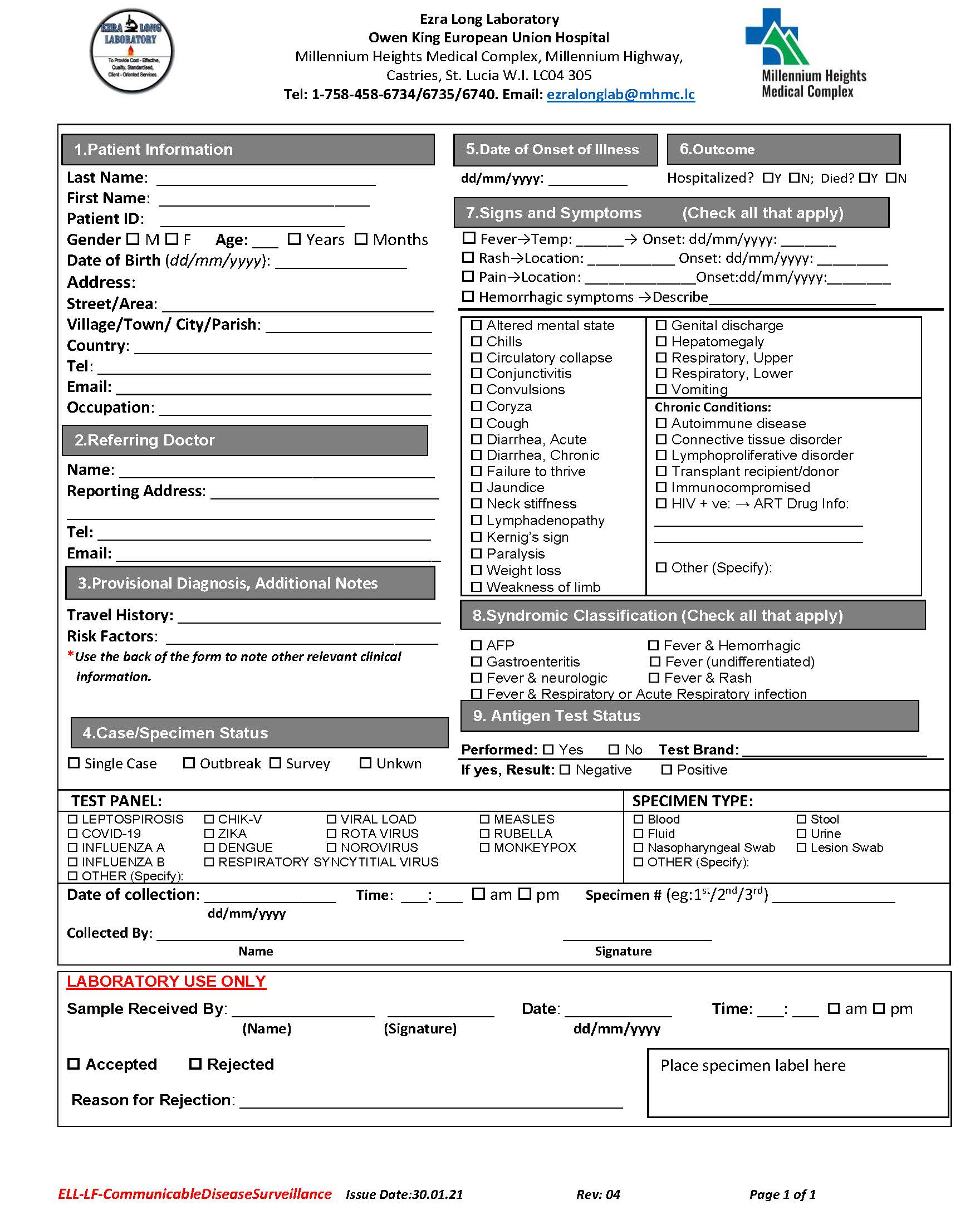
- Label all specimens with: patient name, date of birth, specimen type, date and time of collection, collection facility name, test requested.
- Complete the laboratory request form and attach to specimens.
- Place specimens in a leak-proof primary container, then a secondary sealed container, then a rigid outer packaging.
- Triple packaging required for Category A (UN 2814) transport. Use certified IATA P620-compliant packaging.
- Maintain a cold chain (2–8°C for specimens to be tested within 72 hours; freeze at -70°C for longer storage).
- Inform the receiving laboratory of incoming specimens before dispatch.
- Notify Epi/HIU of specimen dispatch — include specimen ID, patient identifier, and expected laboratory arrival time.
3.9 Laboratory Referral Pathway
In St. Lucia, national laboratory capacity for EVD RT-PCR is not present at this time. The regional reference laboratory CARPHA CMML has confirmed molecular diagnostic capacity for EVD. The following referral pathway applies:
- All samples should be sent to the National lab which will transmit the sample to WHO Collaborating Centre: CDC Viral Special Pathogens Branch (Atlanta, USA) or to the CARPHA CMML (Port-of-Spain, Trinidad and Tobago). Prior coordination with PAHO-ECC is required to ensure the sample is received by CDC. PAHO/WHO will provide support in shipping of samples, where identified.
- Differential diagnoses to rule out before and alongside EVD testing: malaria, dengue, leptospirosis, typhoid fever, yellow fever, chikungunya, influenza, other viral haemorrhagic fevers, meningitis, septicaemia.
Step 4: Reporting - Healthcare Providers / PoE Health Authorities / Epi/HIU / IHR NFP
3.10 Reporting Timelines
| Item | Details |
|---|---|
| Healthcare provider → Epi/HIU | IMMEDIATELY on identification of a suspected case - same day. Do not wait for laboratory confirmation. |
| PoE Health Authority → Epi/HIU | IMMEDIATELY on identification of suspected traveller case or unusual health event on conveyance. Do not wait for disembarking of the plane or ship. |
| Epi/HIU → CMO / Ministry of Health | IMMEDIATELY - same day notification required for all suspected, probable, and confirmed cases. |
| National IHR NFP → WHO (copy PAHO/WHO ECC) | IMMEDIATELY - any suspected, probable, or confirmed EVD case must be reported to WHO through the IHR NFP channel without delay. |
3.11 What to Report
- All suspected, probable, and confirmed EVD cases - including cases ruled out (with reason for ruling out documented).
- Any international traffic-related measures adopted (e.g., enhanced screening protocols, travel advisories, travel or entry restrictions).
- Any unusual clusters of illness among travellers from affected areas even if EVD cannot immediately be confirmed.
- Contact tracing outcomes - number of contacts identified, monitored, symptomatic contacts classified as new suspected cases.
Step 5: Points of Entry - Traveller Screening and Awareness
3.12 Pre-Arrival Actions
- Coordinate with conveyance operators to receive pre-arrival notification of any suspected EVD case identified on board before arrival.
- Review aircraft General Declaration health section or Maritime Declaration of Health for indication of illness on board.
- Pre-position PPE, disinfectants, sample collection kits, and IPC materials at all designated PoEs.
- Ensure isolation space is designated and available at the PoE for health assessment of ill travellers - with access to toilet facilities, water, and seating.
- Ensure availability of interpreters or communication support if needed for travellers from affected regions.
3.13 On Arrival - All Travellers
- Provide arriving travellers with the EVD Public Health Information Card at point of entry, informing them of: EVD symptoms; what to do if symptoms develop within 21 days of arrival; where to seek medical attention; who to contact (national health hotline number).
- Distribute Traveller Public Health Declaration Forms to travellers arriving from or transiting through States Parties with documented EBOV detection (Annex 2).
- All PoE staff to be alert to travellers presenting with visible illness - fever, weakness, unexplained bleeding - especially those arriving from or through DRC, Uganda, or other affected areas.
- Do NOT deny entry to or suspend flights/ship routes from affected countries- this is NOT recommended by WHO under the current temporary recommendations.
3.14 On Arrival - Symptomatic Traveller with Epidemiological Link
- Activate PoE contingency plan.
- Apply full PPE before approaching symptomatic traveller.
- Arrange medical assessment on arrival (or on board prior to arrival where possible).
- Collect information from conveyance operator on any medical assistance provided during travel.
- Notify Epi/Surv and CMO immediately.
- Minimise contact between PoE staff and suspected case or contaminated items.
- Authorise disembarkation of non-ill travellers as appropriate, ensuring contact follow-up protocols are activated.
- Arrange safe transport to designated assessment and isolation facility.
- Arrange cleaning and disinfection of affected PoE areas and conveyance (coordinate approved disinfectant with aircraft/ship operator).
- Initiate contact identification on board (Step 2) - collect passenger locator data.
- Facilitate repatriation of cases and transport of specimens as needed.
3.15 Traveller Information Content
The following information must be communicated to all arriving travellers at risk:
- EVD is transmitted by direct contact with blood or body fluids of symptomatic persons or contaminated objects. It is NOT transmitted by airborne route.
- Being in proximity to a healthy-looking person does NOT constitute a risk.
- Symptoms include: fever, headache, body aches, muscle pain, fatigue, sore throat, nausea, vomiting, diarrhoea, and in some cases unexplained bruising or bleeding.
- If you develop ANY of these symptoms within 21 days of arrival: do NOT go to a public place. Call the national health hotline [insert number] or go directly to the nearest health facility. Inform the healthcare provider of your travel history.
- Avoid contact with blood, body fluids, or tissues of sick people. Do not handle items that may have been in contact with an infected person.
- There is no approved vaccine for EVD.
- Practice careful hand hygiene — alcohol-based hand rub or soap and water.
Step 6: Case Management - Healthcare Providers / Hospitals
3.16 Isolation
- Isolate suspected, probable, and confirmed cases immediately in a single room with a dedicated toilet. If individual rooms are unavailable, cohort isolation is acceptable - keep confirmed cases separate from suspected/probable cases.
- Restrict access to isolation areas: designated healthcare workers only. Maintain a log of all staff and visitors entering.
- Apply contact and droplet precautions for all persons entering the isolation area.
- PPE for isolation area: gloves (double-glove for high-risk procedures), fluid-resistant long-sleeved gown, N-95 or equivalent mask, eye protection, boots or closed shoes.
- Remove PPE before leaving the isolation area using the correct doffing procedure to avoid self-contamination.
- Limit patient movement from isolation to essential purposes only. If transport is necessary, the patient should wear a mask.
3.17 Clinical Management
- No licensed specific therapeutics or vaccines currently exist for EVD. Management is supportive.
- Provide optimised intensive supportive care: oral rehydration or IV fluid replacement with electrolytes; management of pain, fever, and secondary infections.
- Maintain the full package of essential health services for other patients (malaria, maternal health, etc.) with appropriate IPC precautions.
- Establish survivor follow-up programme on discharge: clinical monitoring, counselling, semen testing and sexual health advice (virus may persist in semen for up to 7 weeks after recovery), psychosocial support, stigma reduction.
- For healthcare workers with potential occupational exposure: establish reporting and assessment channels; provide psychosocial support; investigate all exposures for immediate corrective action.
3.18 Environmental Decontamination
- Clean surfaces contaminated with blood or body fluids with water and detergent BEFORE applying disinfectant.
- Disinfect with 0.5% chlorine solution (5000 ppm available chlorine) - contact time minimum 30 minutes. For aircraft, consult aircraft manufacturers for approved products (sodium hypochlorite/bleach is NOT acceptable on aircraft).
- Handle all linen, clothing, and bedding as infectious. Place in sealed bags before removal from the isolation area. Do not hand-wash contaminated items.
- All waste from the isolation area is clinical infectious waste - dispose of by incineration. If waste must be delivered ashore (ship context), notify port authority before delivery.
- Staff cleaning contaminated areas must wear heavy-duty gloves, impermeable gown, eye protection, and closed shoes.
3.19 Safe and Dignified Burial
- If a case dies, the body must be managed under full biosafety conditions. Do not embalm.
- Disinfect body with 0.5% chlorine solution; place in sealed, fluid-resistant body bag; place in closed casket before burial.
- The burial team must be trained and equipped by national health authorities. Full PPE at all times when handling the deceased.
- Arrange for family presence and cultural practices where possible, in consultation with the burial team.
- Prevent cross-border movement of human remains of deceased suspected, probable, or confirmed EVD cases unless authorised through bilateral arrangements.
Step 7: Data Management - Epi/Surv
3.20 Data Collection and Management
- Complete the EVD Case Reporting Form (Annex 1) for every suspected, probable, and confirmed case.
- Maintain an EVD case line list - update daily during active investigations.
- Maintain an EVD alert register - log all reports received, investigation outcome, and final case classification.
- Maintain a contact tracking register - record all contacts, monitoring status, and outcomes.
- Clean and analyse data regularly. Prepare epidemiological situation reports.
- Disseminate weekly situation reports to relevant national and regional stakeholders during active investigation periods.
- Share data with PAHO/WHO ECC in accordance with IHR NFP reporting obligations.
3.21 Surveillance Quality Indicators
| Item | Details |
|---|---|
| Case detection timeliness | Proportion of suspected cases reported to Epi/HIU within 24 hours of clinical identification. |
| Specimen testing rate | Proportion of suspected cases for which laboratory specimens were collected and tested. |
| Laboratory result turnaround | Proportion of suspected cases for which laboratory results are available within 72 hours of specimen collection. |
| Contact identification completeness | Proportion of confirmed and probable cases with identified and listed contacts. |
| Contact monitoring completeness | Proportion of contacts monitored for full 21-day period without data gap. |
| IHR reporting compliance | Proportion of confirmed cases reported to WHO within required timeframe. |
| Case investigation completeness | Proportion of probable and confirmed cases with complete clinical, exposure, and epidemiological data. |
4. Training And Preparedness
- All healthcare providers, PoE staff, laboratory staff, and first responders must receive EVD awareness training before activation of this SOP. Training must cover: EVD transmission and case definition; IPC and PPE use; reporting procedures; specimen collection; contact management.
- PoE health authorities should conduct simulation exercises covering detection and management of a EVD alert at sea and airport PoEs, including cross-border contact sharing scenarios.
- NGOs and entities deploying personnel internationally to respond to the EVD epidemic must be provided with information on risk, exposure minimisation, and post-exposure management.
- Prepare to facilitate the evacuation and repatriation of nationals (including health workers) who have been exposed to EVD cases in affected areas.
- Identify laboratories qualified to test for EBOV; establish specimen referral pathways and test kit pre-positioning before a case is suspected.
- Training materials and updated EVD guidance are available at: https://www.who.int/emergencies/alert-and-response
ANNEX 1 - EVD CASE REPORTING FORM / CASE INVESTIGATION FORM
Complete this form for every suspected, probable, and confirmed EVD case. Submit to Epi/HIU immediately on completion. For confirmed cases, this form is the primary data source for IHR NFP reporting to WHO.
| No | Information | Variable | Description | Response / List |
|---|---|---|---|---|
| SECTION 1: CASE DEMOGRAPHICS | ||||
| 1 | Record ID | RecordID | Unique case identifier assigned by Epi/HIU | TEXT |
| 2 | Reporting Country | ReportingCountry | The ECC country reporting the case | Antigua and Barbuda / Dominica / Grenada / Saint Kitts and Nevis / Saint Lucia / Saint Vincent and the Grenadines |
| 3 | Case Classification | CaseClassification | Current classification at time of form completion | Suspected / Probable / Confirmed / Non-case |
| 4 | Date of Report | DateOfReport | Date this form was completed | DATE (dd-mm-yyyy) |
| 5 | Date of Clinical Diagnosis | DateDiagnosis | First date of clinical identification | DATE (dd-mm-yyyy) |
| 6 | Age (years) | Age | Age in years; enter 0 if under 1 year | NUM |
| 7 | Sex at Birth | Sex | Sex at birth | Female / Male / Other / Unknown |
| 8 | Nationality | Nationality | Nationality of case | TEXT |
| 9 | Occupation | Occupation | Occupation relevant to exposure risk | Healthcare worker / Traveller / Lab worker / Other / Unknown |
| 10 | Is case a healthcare worker? | HCW | Was the case working in a healthcare setting? | Yes / No / Unknown |
| SECTION 2: CLINICAL PRESENTATION | ||||
| 11 | Symptoms present? | Symptomatic | Does/did the case have symptoms? | Yes / No / Unknown |
| 12 | Date of symptom onset | DateOnset | Date first symptoms appeared | DATE (dd-mm-yyyy) |
| 13 | Fever (≥38°C) | Fever | Fever at or above 38°C or feeling feverish | Yes / No / Unknown |
| 14 | Headache / body aches / muscle pain | Headache | Headache, myalgia, fatigue, or sore throat | Yes / No / Unknown |
| 15 | GI symptoms | GIsymptoms | Abdominal pain, diarrhoea, or vomiting | Yes / No / Unknown |
| 16 | Unexplained bruising or bleeding | Haemorrhage | Any unexplained bruising or bleeding from any site | Yes / No / Unknown |
| 17 | Hospitalised? | Hospitalised | Has the case been hospitalised? | Yes — isolation only / Yes — clinical need / No / Unknown |
| 18 | ICU admission? | ICU | Case admitted to intensive care unit | Yes / No / Unknown |
| 19 | Outcome | Outcome | Current status or outcome | Alive — under care / Alive — discharged / Died / Unknown |
| 20 | Date of death (if applicable) | DateDeath | Date of death if outcome is death | DATE (dd-mm-yyyy) |
| SECTION 3: TRAVEL AND EXPOSURE HISTORY (21 days before symptom onset) | ||||
| 21 | Travel to affected area? | TravelAffected | Travelled to area with documented EBOV transmission in past 21 days? | Yes / No / Unknown |
| 22 | Countries visited (last 21 days) | CountriesVisited | List all countries visited in past 21 days, most recent first | TEXT (list all) |
| 23 | Direct contact with EVD case? | ContactEVD | Direct contact with suspected/probable/confirmed EVD case? | Yes / No / Unknown |
| 24 | Healthcare facility exposure? | HCFExposure | Worked in or visited HCF treating EVD patients without PPE? | Yes / No / Unknown |
| 25 | Contact with EVD deceased? | DeceasedContact | Touched body of person who died with EVD without PPE? | Yes / No / Unknown |
| 26 | Laboratory exposure? | LabExposure | Worked in laboratory handling EVD specimens without full PPE? | Yes / No / Unknown |
| SECTION 4: LABORATORY | ||||
| 27 | Specimens collected? | SpecimenCollected | Were laboratory specimens collected from this case? | Yes / No / Pending |
| 28 | Date of specimen collection | DateSpecimen | Date specimen was collected | DATE (dd-mm-yyyy) |
| 29 | Specimen type | SpecimenType | Type of specimen collected | Whole blood / Serum / Lesion swab / Other |
| 30 | Laboratory result | LabResult | RT-PCR result for EBOV | Positive / Negative / Inconclusive / Pending / Not done |
| 31 | Date of result | DateResult | Date laboratory result was received | DATE (dd-mm-yyyy) |
| 32 | Laboratory performing test | Laboratory | Name and location of testing laboratory | TEXT |
| 33 | Specimen sent to reference lab? | RefLabSent | Was specimen sent for reference lab confirmation? | Yes / No / Pending |
| SECTION 5: CONTACT INVESTIGATION | ||||
| 34 | Contacts identified? | ContactsID | Were contacts of this case identified? | Yes / No |
| 35 | Number of contacts | NumContacts | Total number of contacts identified | NUM |
| 36 | Contacts under monitoring? | ContactsMonitor | Are all contacts currently under 21-day monitoring? | Yes / Partial / No |
| 37 | Any contacts symptomatic? | ContactsSx | Have any contacts developed symptoms? | Yes / No / Unknown |
| SECTION 6: REPORTING AND NOTIFICATION | ||||
| 38 | Reported to CMO? | ReportedCMO | Was CMO/Ministry of Health notified? | Yes / No — Date: __/__/____ |
| 39 | Reported to WHO via IHR NFP? | ReportedWHO | Was case reported to WHO via IHR NFP? | Yes / No — Date: __/__/____ |
| 40 | Reported to PAHO/WHO ECC? | ReportedPAHO | Was PAHO/WHO ECC informed? | Yes / No — Date: __/__/____ |
| 41 | Form completed by | CompletedBy | Name, title, and institution of person completing form | TEXT |
| 42 | Date form completed | DateForm | Date this form was completed | DATE (dd-mm-yyyy) |
ANNEX 2 - TRAVELLER PUBLIC HEALTH DECLARATION FORM
TRAVELLER PUBLIC HEALTH DECLARATION FORM
Please complete this form fully. The information will be used by public health authorities in accordance with applicable national laws.
| Field | Response |
|---|---|
| Last (family) name | ……..……..……..…….….….…..……..…….. |
| First (given) name | …..……..……..……..……………..… |
| Birth date | Day ….…… |
| Sex | Male ……… |
| Passport country | ……..……..…..…..…….….…..……..…….. |
| Passport number | ……..……..…..…..…….….……..…..…… |
| Arrival date | Day ….…… |
| ……..………..………...……….…….……..…. | |
| Telephone (include country code) | …..……..……......…......…...........................…..……..……. |
| Home address | ..……..……..……..……..……..…….……..……..……..…….……..………..……..……..…… |
| Address / contact for next 21 days | .……..……..……..……..……..……..……..……..……..………………….. |
| Today or in the past 48 hours, have you had any of the following symptoms? | YES | NO |
|---|---|---|
| a. Fever (38°C / 100.4°F or higher), feeling feverish, or having chills? | ☐ | ☐ |
| b. Headache, body aches, muscle pain, fatigue, loss of appetite, or sore throat? | ☐ | ☐ |
| c. Abdominal pain, diarrhoea, or vomiting? | ☐ | ☐ |
| d. Unexplained bruising or bleeding from any part of the body? | ☐ | ☐ |
| In the past 21 days, have you done any of the following? | YES | NO |
| e. Lived in the same household or had close contact with a person sick with Ebola Virus Disease (EVD)? | ☐ | ☐ |
| f. Worked in a healthcare facility treating EVD patients or a laboratory analysing EVD specimens, or touched the body of someone who died with EVD, without using personal protective equipment (PPE)? | ☐ | ☐ |
Countries visited in the past 21 days (list all countries, including port transits and where you live. List the most recent country first):
| No. | Country / Transit | No. | Country / Transit |
|---|---|---|---|
| 1 | ………………………….………….…………………………… | 2 | ………………………….……………………………………….. |
| 3 | ………………………….………….…………………………… | 4 | ………………………….……………………………………….. |
| 5 | ………………………….………….…………………………… | 6 | ………………………….……………………………………….. |
LAB Form
References
- WHO Temporary Recommendations for Ebola Virus Disease PHEIC, 19 May 2026. Geneva: World Health Organization, 2026.
- Technical Note: Implementation of IHR Emergency Committee recommendations for countries not neighbouring areas with documented Ebola Virus Disease. Geneva: WHO, May 2026.
- WHO Interim Guidance: Considerations for border health and points of entry for filovirus disease outbreaks. Geneva: WHO, 2024.
- WHO Interim Guidance: Travel and transport risk assessment for public health authorities and the transport sector (EVD context). Geneva: WHO, September 2014 (WHO/EVD/Guidance/TravelTransportRisk/14.1).
- WHO Interim Guidance: Ebola Event Management at Points of Entry. Geneva: WHO, September 2014 (WHO/EVD/Guidance/PoE/14.1).
- PAHO/WHO. Ebola virus disease — implications of introduction in the Americas. Corrigendum, 13 August 2014.
- SOP: Surveillance of Mpox, Eastern Caribbean Countries, PAHO/WHO ECC. Version 1.0. [Reference document for SOP structure and formatting].
- International Health Regulations (2005), second edition. Geneva: WHO, 2008.
- Risk Assessment Guidelines for Infectious Diseases Transmitted on Aircraft (RAGIDA), Part 2: Operational Guidelines, 2nd edition. Stockholm: ECDC, November 2009.
- IATA. Suspected communicable disease: general guidelines for cabin crew. Montreal: International Air Transport Association, 2011.
- Daily EVD epidemiological updates: https://www.who.int/emergencies/alert-and-response